Showing posts with label Conwy. Show all posts

Thursday, 16 March 2017

Harddwych Gogledd Cymru - The Beauty of North Wales Part III

In the first two parts of this tour around North Wales, we looked at Castles, Palaces and Churches. But there are many domestic dwellings of less majestic proportions to be seen, that have neither crenelation nor spire.

Close to Pwllheli, and down a track which looks like it's the ultimate road to nowhere, is the medieval house known as Penarth Fawr. A fifteenth century hall-house, it is beautifully preserved and maintained by CADW, if sparsely presented. I've been twice, and both times there was not another soul around. There is no information about who lived here, but one can get a sense of how they lived. CADW's approach to such buildings is to maintain and preserve them, without much fanfare or adornment. No furniture has been added to this property, but its emptiness and the silence of the setting triggers the imagination, even so.

Penarth Fawr - CADW

Maintained by another organisation, this time the National Trust, Ty Mawr Wybrnant is a sixteenth century stone-built farmhouse and is famous for having been the birthplace of Bishop William Morgan, who first translated the Bible into Welsh. 


Photo - Wiki commons attribution Nancy - author

Some houses of the early modern age are much grander. Gwydir Castle near Llanrwst was the home of the prosperous Wynn family, whose fortunes were at their zenith in the Tudor and Stuart era. The castle was rebuilt following the Wars of the Roses by Meredith ap Ieuan ap Robert, founder of the Wynn dynasty and a supporter of Henry VII. Gwydir claims links with the Babington Plot of 1586, the Gunpowder Plot of 1605, Charles I, and the aforementioned Bishop Morgan. We were lucky enough to visit after the current owners had bought back and refitted the wood panelling in the dining room which had been stripped in the 1920s and purchased by William Randolph Hearst. 


Photo by Dara Jasumani CCBY-SA 2.0

Gwydir is reputedly haunted, as is Plas yn Rhiw, on the tip of the Llyn Peninsula. The tourism literature focuses on the restoration work of the Sisters Keating, who moved there in 1939. But the house dates back to the seventeenth century. (For a while it was leased to the owners of Sizergh Castle just down the road from where I live in the Lake District.) It is suggested that Rhodri Mawr (the Great) who ruled in the 9th century, built a house near this site, and it is not unusual to find Tudor and Jacobean buildings on the sites of previous houses. Here though, no trace remains of earlier occupancy, and visitors are drawn to the gardens, and the ruined watermill therein, and the woodlands surrounding the property.


Plas Mawr - CADW
In Conwy, there are two examples of domestic dwellings. The first is Quay House, known as the smallest house in Britain, and which dates from the sixteenth century, while the second is Plas Mawr (Mawr meaning 'large' or 'great'). This was also owned by the Wynn family of Gwydir. Take a tour of the interior, which is furnished according to an inventory of 1665. Herbs hanging in the kitchen and the ornate plasterwork give a real 'feel' for how the place would have been in its heyday.

Conwy is also famous for its castle, but alongside that is the feat of Telford's engineering, the Conwy Suspension Bridge. Modern day visitors to this area wishing to traverse the Menai Strait have a choice of bridge: The Menai Bridge was also built by Thomas Telford, while the Britannia Bridge was built by Robert Stephenson, son of George.


And so we move to the Industrial era. Grand 'castles' were built by industrialists, who grew rich from the proceeds of Jamaican sugar and local Slate (Penrhyn - pictured below left) and lead mining (Bodelwyddan)


Sadly the Clogau gold mine in Bontddu near Barmouth is no longer accessible, but it is possible to visit the Inigo Jones slate works near Caernarfon which gives a full history of the slate industry and a chance to try slate carving for yourself (harder than it looks!) Take a trip to Blaenau Ffestiniog (you can go by train from Caernarfon) and witness the legacy of slate mining in the area. Or visit Parys Mountain near Amlwch on the northern coast of Anglesey to discover the history of copper mining (my own photo, below.)


A reminder of gentler industry takes the form of Melin Llynon which is a restored and fully working windmill in the centre of Anglesey (my photo, below.)


Before we leave the island at the end of this three-part tour round the area, mention should be made of Plas Newydd, a slightly grander building than the homes we began this section with.
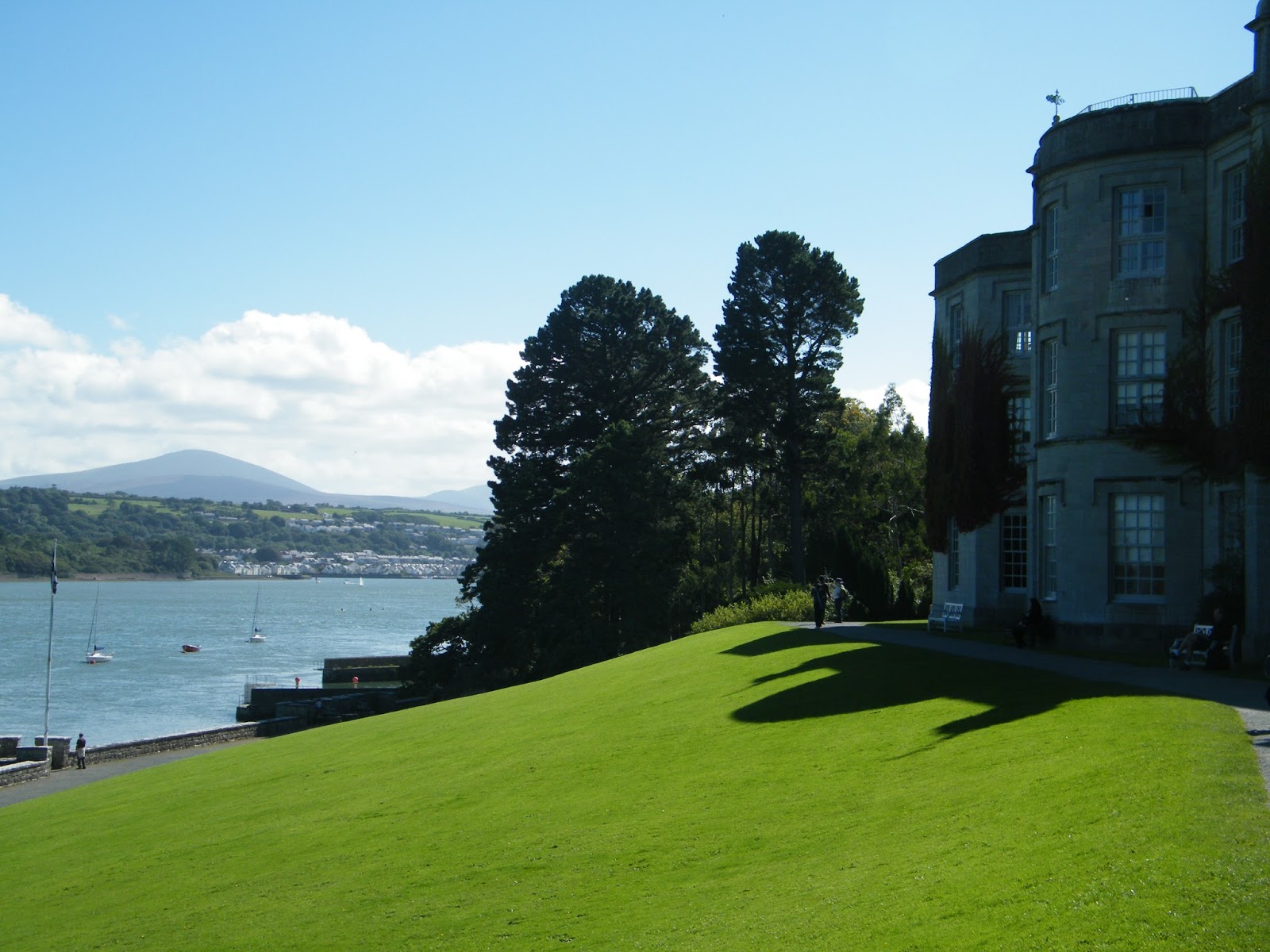
My own photo of the house, garden and Menai Strait
It was the home of the first Marquess of Anglesey, who famously lost a leg at Waterloo. Inside there are photographs of the original family home at Beaudesert in Staffordshire, destroyed by fire. Last time I visited, the current Marquess had recently died, and had never visited Beaudesert, which the family still call home, because it would have 'broken his heart', yet the staff all go on an annual trip there, paid for by the family.

Trips and days out remain popular and the Victorians liked them too. On this tour we've already been to Trefiw, favourite of Llewelyn Fawr in the thirteenth century, but it became popular in the nineteenth, too, when the famous spa was excavated and the benefits of drinking the iron-rich water brought health-seeking gentlefolk to the area.

I apologise for any omissions; over three posts I've barely strayed beyond the confines of this map, and yet the places mentioned do not constitute an exhaustive list.

I've not had time to look at Iron Age hill forts or Roman remains, but whichever period of history you are interested in, North Wales will have something for you. Do go, if you can.

Links to Parts I & II

Thursday, 16 February 2017

Harddwych Gogledd Cymru - The Beauty of North Wales Part II

The first thing you might notice about Wales, and North Wales in particular, is that there are rather a lot of castles. They are usually lumped together as "Welsh Castles" but some are Welsh, and some are 'English'. On our first trip in 2004, we visited as many as we could. From the dark and brooding Dolwyddelan, Criccieth, Dolbardarn (all Welsh,) to the castles which formed the Iron Ring of Edward I's campaign of subjugation - Harlech, Conwy, Caernarfon, Beaumaris... But I'd like to begin this second leg of our tour of North Wales not with the castles, but with some of the places associated with the Princes of Gwynedd.


Author's own photo
Those who've read Sharon Penman's Welsh novels will be familiar with the story of Llewelyn Fawr (the Great) and his English wife, Joan (Joanna) who was the natural daughter of King John. In the church of Saint Grwst in Llanrwst lies the stone coffin, reputed to be that of Llewelyn, who died on April 11th AD1240. Over on Anglesey in the town of Beaumaris, the parish church porch houses Joan's coffin.

Like all medieval princes, Llewelyn was fairly peripatetic and one of his favourite places was his hunting lodge at Trefriw. The story goes that Joan took exception to walking up to the little chapel above Trefiw. But I can recommend that the climb rewards the effort. Services are still held in this 11th century church, and there is evidence that there has been a church here since the 6th century.

The medieval chapel at Llanrhychwyn -  author's photo
A new church was built in Trefiw in around 1230 on the site where St Mary's now stands, where stained glass windows devoted to the royal couple can be seen.
So we can visit these people in death, and see where they prayed, but can we visit where they lived? Well, yes, up to a point. The royal palace at Aberffraw is buried under a housing estate, and there is an ongoing debate as to the exact location of the palace at Abergwyngregyn. In the village there is a raised mound, which has been suggested as some kind of motte, but there is also an old manor house, Pen y Bryn,  dating back to the 17th century which, it is claimed by some, was built on the site of the former palace.

The priory at Llanfaes, where Joan was sent by Llewelyn after an indiscretion, has also long since gone. But in Newborough, the royal 'Llys' has been partially excavated. Drive round the corner too quickly and you'll miss it, in the field above the road, but it's there. Here, at Llys Rhosyr, it is possible to see the footings of the original buildings as well as the views across to the mainland.

author's own photo - Snowdonia in background
I've been to this site two or three times over the last decade and it seems to me that there has been sporadic investigation in the intervening periods, with information boards now erected, and directional stones inscribed with information about the layout of the site. (Readers of Part I of this journey through the area will remember that further along this road is the beach, which leads to Llanddwyn Island.)


Here is my photograph of one of those information boards, showing how the site might have looked. But of course, much of life was spent not in houses, but castles - the construction for which North Wales is famed.

Many of these castles belonged to the Welsh Princes, and it's believed that Llewelyn Fawr was born in an earlier building on the site of Dolwyddelan Castle, which he had built. It offers commanding views of the surrounding landscape, and part of it is still intact. For atmosphere and a feel of the past, it's hard to beat.
Dolwyddelan Castle - my father's photo, and the header for this blog
Other 'native' castles include Criccieth on the Llyn Peninsula. When I visited there in 2004 there was an informative exhibition dedicated to Gerald of Wales, the 12th century chronicler. Standing like a sentinel high above Llanberis and overlooking the lake called Llyn Padarn is the ruin of Dolbadarn Castle, where Llewelyn's grandson, also called Llewelyn, imprisoned his brother, Owain ap Gruffudd. (Brotherly love was generally in short supply in that particular family.)

Like Criccieth, some native castles were taken over by Edward I and extended. At Rhuddlan, Edward went further still and altered the course of the river Clwyd when he built the castle there. Rhuddlan is not as well known, perhaps, as the major Edwardian castles which make up the 'Iron Ring'. Llewelyn Fawr's grandson poignantly became known to history as Llewelyn the Last, defeated by Edward in 1282. Edward began a massive programme of building, using the 'concentric' design of a castle within a castle. He was determined that the Welsh would remain subjugated and at Conwy Castle, he used stones from Aberconwy Abbey which had been the resting place of several Welsh princes. It was a powerful symbol of conquest.

This picture of Caernarfon Castle shows how impenetrable and formidable these structures appeared to be. And yet Caernarfon was breached, in an uprising of 1294 led by Madog ap Llewelyn and was besieged again during the uprising of Owain Glyndwr (AD1400-1415).

In this, Caernarfon has something in common with Harlech Castle, which was occupied by Owain's forces between 1404 and 1409.


But Caernarfon also shares a secret with Beaumaris Castle on Anglesey, in that it was never actually finished. Wander round Caernarfon and you might not realise, since most castles these days are at least partially ruined. But step inside Beaumaris and you will see that only the outer walls were completed and the castle was never fully inhabited.


The unfinished north gatehouse - Jeff Buck
In over a decade of at least twice-yearly trips, I still haven't visited the sites of all the Welsh castles. All of these sites are well worth a visit; some have a castle or a church to display. Some have much more to show off. Please join me in Part III of this tour when we will go back to Trefriw to visit a haunted Tudor castle and taste the iron water which drew the Victorians to the area. Back in Conwy we will visit two Tudor houses and a suspension bridge built by Telford. And after taking in a couple more Tudor buildings, we'll further explore the changes wrought by the Victorians on the landscape of this beautiful corner of Wales.